How to Verify Chinese Herb Quality Before You Import
Posted on August 12, 2026
In 2024, a German nutraceutical importer lost a full container of dried red dates at Hamburg customs. The reason: cadmium levels exceeded EU limits by 18%. The supplier had provided a COA — but it was issued by a third-party lab that tested a different batch. Nobody had verified whether the certificate matched the shipment. The €47,000 loss was preventable.
For buyers importing Chinese herbal medicine, spices, or botanical teas, quality verification is not a paperwork formality — it is the single largest financial risk in the transaction. A shipment that fails testing at the port of entry becomes a liability: disposal costs, demurrage fees, and in some jurisdictions, regulatory penalties. The difference between a smooth clearance and a rejected container comes down to three lab results.
The Three Numbers That Matter
Every Certificate of Analysis should address exactly three categories. If your supplier's COA is missing any of them, the document is incomplete.
1. Heavy metals. Lead (Pb), cadmium (Cd), mercury (Hg), and arsenic (As) are the standard panel. Different markets enforce different limits: the EU Pharmacopoeia sets cadmium at ≤1.0 mg/kg for most dried botanicals, while the USP allows ≤0.5 mg/kg for certain categories. China's own GB 2762-2022 standard adds chromium and nickel to the panel for specific herb types. If you are importing ginseng root, which bioaccumulates cadmium from soil, heavy metal testing is non-negotiable.
2. Pesticide residues. The EU MRL (Maximum Residue Limit) database covers over 400 active substances for botanical materials. The FDA uses a different reference — EPA tolerances, enforced through import alerts. A single detection above the threshold can trigger automatic detention without physical examination (DWPE) on future shipments under the same manufacturer name. For organic-certified orders, the bar is higher: any detectable synthetic pesticide, even below MRL, can void the organic claim. We have shipped organic red dates and organic rose petals to U.S. buyers under the USDA NOP standard — products with delicate tissue and high surface area that demand near-zero residue levels throughout the drying and storage chain.
3. Potency and identity. This is the category most COAs underreport. Heavy metals and pesticides are pass/fail — either you are under the limit or you are not. But potency testing answers a different question: are you actually getting the species and active compound concentration you paid for? Astragalus root (Huang Qi) should deliver astragaloside IV at ≥0.04%. Goji berry polysaccharide content varies by a factor of two depending on the growing region and harvest timing. Without potency data on the COA, you are buying by appearance alone.
Before you place an order, ask your supplier one question: "Is the COA issued for this specific batch, or is it a representative certificate?" A batch-specific COA means the lab tested the actual material in your shipment. A representative COA means they tested a sample six months ago and are reusing the document.
What a Real Testing Lab Looks Like
Most suppliers describe their quality control in adjectives — "strict," "comprehensive," "international standard." A buyer should look for evidence of equipment and process instead.
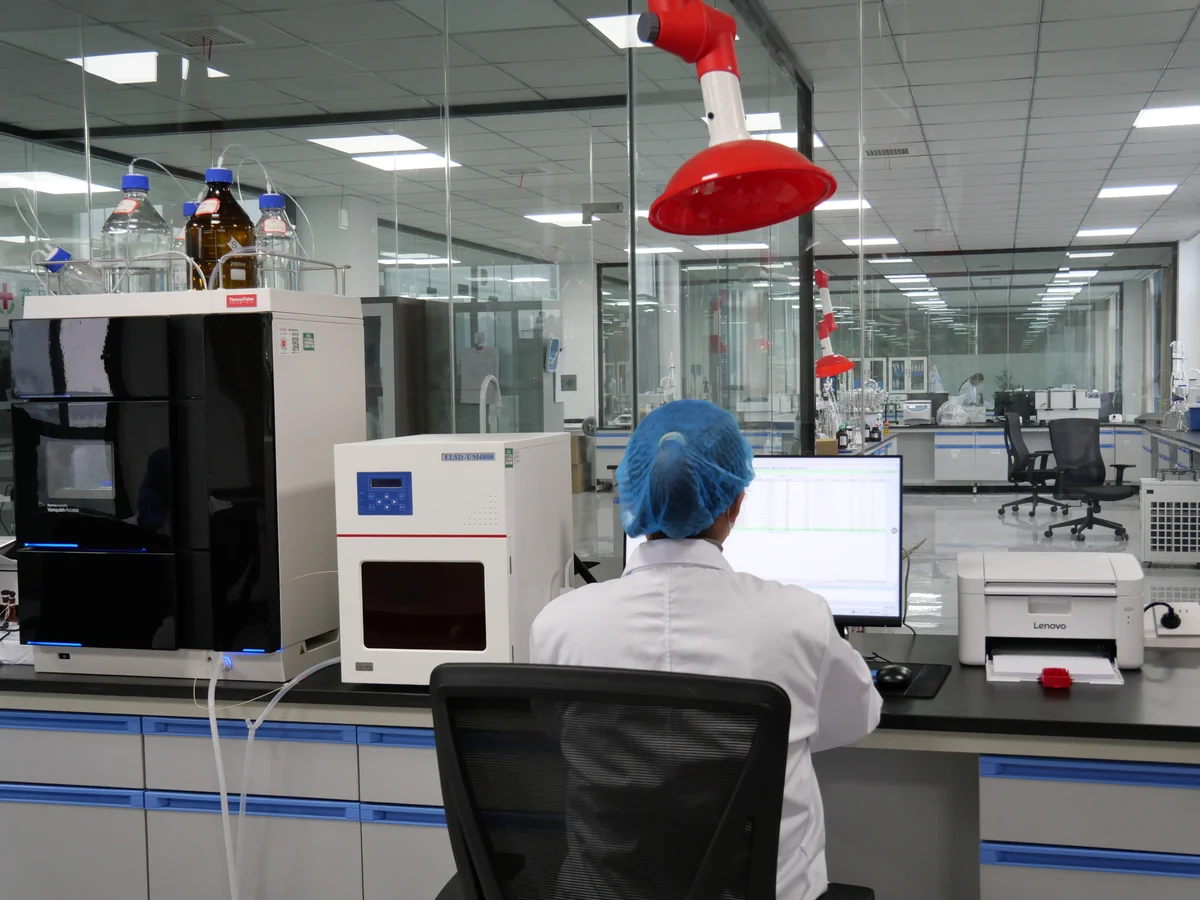
At Zhouhetang's GMP-certified Bozhou facility, every incoming raw material lot is quarantined until the in-house lab clears it. The lab runs atomic absorption spectrometry (AAS) for heavy metals, gas chromatography-mass spectrometry (GC-MS) for pesticide residues, and high-performance liquid chromatography (HPLC) for marker compound potency. Results are logged against the batch number before the material moves to processing.
For buyers sourcing powdered herbal extracts for beverage or supplement formulations, chemical testing alone is insufficient. A complete QC report should also include physical parameters: water solubility (critical for instant tea powders and drink mixes), particle size distribution (laser diffraction, reported as D50/D90), and bulk density. A powder that passes every chemical test but clumps on contact with water will fail in production. Our lab measures solubility across temperature gradients — cold water solubility for ready-to-drink formulations, hot water solubility for traditional preparation methods — and reports both on the COA when specified.
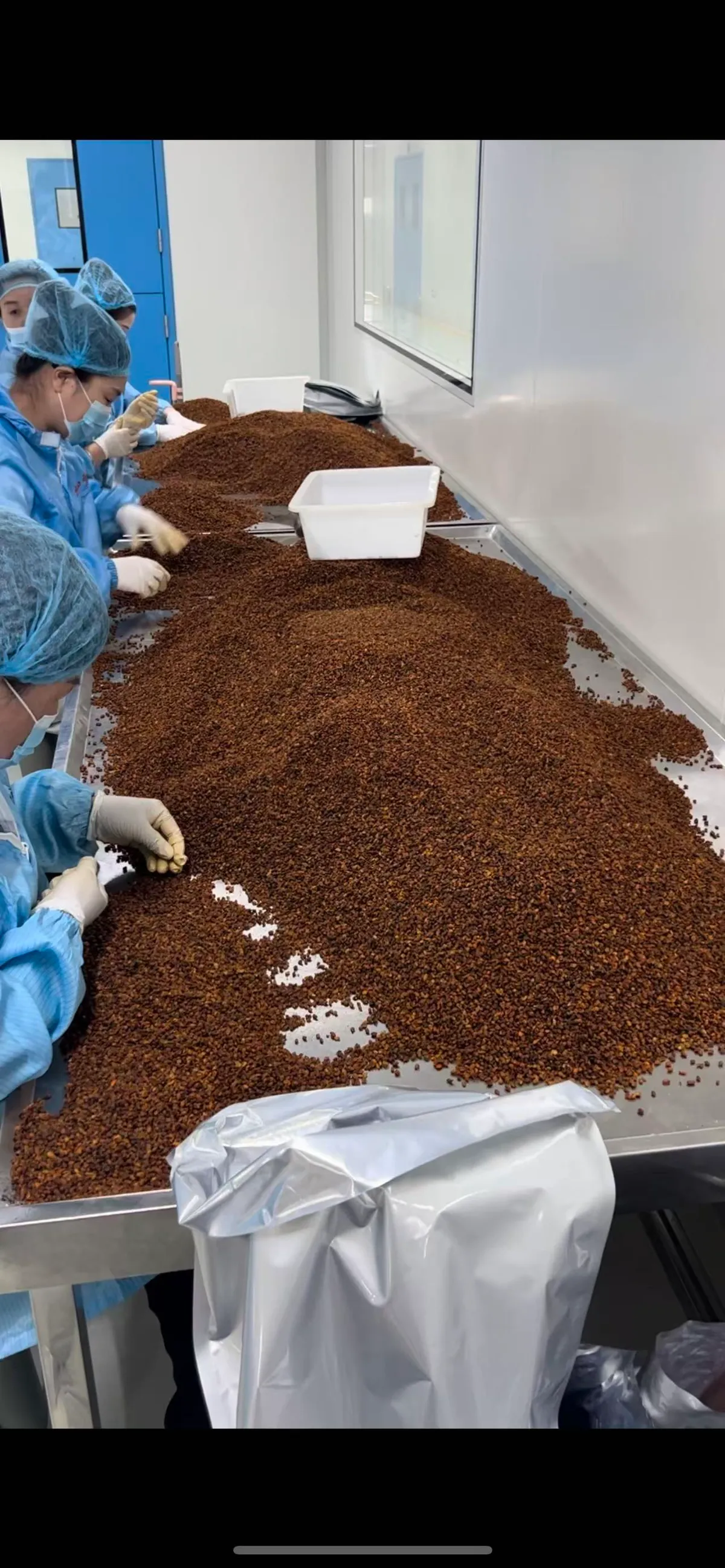
The photo above shows a routine quality step that automated sorting cannot fully replace. For sea buckthorn berries, trained workers remove under-ripe fruit, stems, and foreign material by hand before the dried berries enter grinding or packaging. This is labor-intensive, but it is the only way to guarantee the 98%+ purity that industrial extraction buyers require.
"Quality is our pursuit — not just as a slogan, but as a daily standard you can verify. Every batch that leaves our facility carries a COA with real test data, not a template. If you want to see the actual chromatogram for your order, we'll send it."
— Able, Senior Export Director, Zhouhetang Herb
Direct Sourcing vs. Blind Buying
When you buy through a trading company, the COA you receive is typically issued by a lab you have never visited, for a lot you cannot trace, under a supply agreement you are not party to. The documentation chain breaks at the first intermediary.
Buying directly from a manufacturer with an in-house lab changes the verification timeline. You can request:
- Pre-shipment samples with batch-specific COA before the container leaves Bozhou
- Third-party verification at an external ISO 17025 lab, cross-referenced against the in-house results
- Factory audit rights — visit the lab and processing floors yourself, or send a local inspector
None of these are available when buying through four layers of intermediaries. The choice between direct sourcing and blind buying is, at its core, a choice about whether you want to verify quality before payment or discover problems after delivery.
For buyers building product lines around verified ingredients, the QC advantage compounds. A classic longan-red date-goji tea blend — three ingredients, each covered by the testing protocols described above — becomes not just a product but a documented quality proposition. When your label claims "lab-tested for purity," the documentation chain from Zhouhetang's in-house lab to your retail package is intact. That is the difference between private-label OEM at the commodity level and building a brand with verifiable quality credentials.
Request a Batch-Specific COA for Your Next Order
Contact the Zhouhetang export team to discuss your quality specifications — from heavy metal limits to marker compound targets for herbs, spices, or tea.
Request a Quote →Batch-specific COA with every order · Pre-shipment samples available · Factory audits welcomed